Short stories
World Games Day
The Bridport Prize, Short Story Shortlist
2024
Aaron listened under the stairs. The house creaked. He liked it when the house creaked. It was exciting in a deferred moment of peril way. Somewhere near the kitchen, at the end of the L-shaped corridor, was his sister Abigail. She would also be waiting and listening. Abigail was good at this game, which they had modified from earlier years. They were teenagers now, into stronger excitement than his Action Man rescuing her Cindy doll. They wanted their kicks. Aaron had brought his friends over, and Abigail had brought her friends over. Their mother, Katherine, was out in the fields trying to keep safe.
Abigail waited at the end of the corridor, where it was dark at the junction of the boiler room, scullery, and kitchen. She knew Aaron was up ahead, hiding under the stairs. She also knew her girlfriends would be moving silently through the house. Time To Get Rid of Boys. It was World Games Day. They were well past Cindy dolls and Action Man now. Their dog, Montelukast, had run off across the fields at the first opportunity. Monty had not looked back. Monty knew that things were going to get messy.
Baird was hiding behind Aaron under the stairs. Baird had in his right hand a Roman soldier’s gladius, half out of its scabbard. Puberty had hit the red button and things had changed for all of them. They were looking for stronger excitement than Toy Story now. Baird also had a light crossbow in his left hand. His father had helped him to make it out of a beautiful piece of red oak. Baird had loaded a six-inch bolt, and the bowstring was wound back. The damage this small weapon could unleash beat Dungeons and Dragons any day of the week. And it was legal. It was World Games Day. Overpopulation was a global problem.
Barbara waited behind the kitchen door. The kitchen table was white with flour. The oven was cooling. Katherine had baked a peace offering: a Victoria sponge, a tray of cookies. She had also made lemonade. The oven was on outside; it was sweltering. Little winged insects called thrips flew in through the open windows and coated their faces with black smudges like camouflage. But cakes and cookies were not what the kids were after. Katherine had realised that and had disappeared. Aaron and Abigail’s father, Leonard, had decided he needed to go to work, even though it was a Saturday.
Barbara could hear Abigail breathing, but it was not Abigail’s fault. Barbara had superb hearing. She could, for instance, hear the boy who was hiding in the boiler room. Every so often, he shuffled on his bum where he sat on top of the boiler. Barbara would either deal with the boy, or warn Abigail, who would take care of him instead. Or they would make another move as dictated by whatever the girlfriends needed most. Down With Boys. All their looks and body scans and insinuations. The girls had waited patiently for World Games Day, and they were ready.
Cadman camped in the boiler room. He sat on top of the boiler and stared at the key in the lock of the boiler room door. The door was locked but it was made of a light and flimsy plywood that could easily be broken down. Outside were one or more girls, including Abigail, Aaron’s sister, the ring leader. Cadman knew it had been a mistake to hide in the boiler room. There was no window to escape through. It was in the nineties outside, and he was sweating buckets inside. He was fearful. He only had his bare hands. He had heard that the girlfriends fought like wild cats. What could he use for a weapon? There was a bunch of keys hanging from a hook. He imagined taking the pointiest key, holding it between his fingers, and stabbing an eye.
Caitlin suddenly appeared in front of Abigail. She had moved quickly from the dining room, next to the kitchen, keeping an eye on where Aaron and Baird hid under the stairs. She placed a finger on her lips and shushed Abigail and Barbara. She held up two fingers, in a V sign, and jabbed them towards the stairs. Abigal and Barbara nodded. Once upon a time, Aaron had led Caitlin on, and then when it had mattered most, he had let her down. There is nothing like a woman scorned, especially a young woman. Caitlin’s green eyes flashed. Her red hair was on fire. It would be three against two, a simple attack. Two fewer boys to offend them.
Dale crept into the scullery from outside. He closed the back door behind him quietly, or so he thought. The scullery housed a chest freezer, washing machine, and a large porcelain sink with a wooden draining board. There was a cupboard which held household cleaning materials. He remembered that the cupboard door was closed by a noisy ball bearing device that would make a loud click and get him killed. There must be something else useful in the scullery. But it all smelt so clean, of soap and laundry powder. There was a white clothes line hung across the length of the room with a variety of tea towels and hand towels drying. Then Dale saw a garden tool hidden behind the cupboard. He looked closely: it was a hoe with a three-pronged fork on one side of the blade.
Caitlin turned around and looked at the scullery door. Something had moved in the room. She drew her dagger and Abigail got out of the way. Caitlin approached the flimsy brown wooden door (all the doors in the house were brown and flimsy she had noticed) and stood listening. She bent down and looked through the key hole. Abigail saw her smile. Caitlin stood up and got ready. Barbara handed her an item from the kitchen that she would need. The three girls looked at one another. Caitlin opened the door and entered the scullery quickly. Abigail closed the door. Barbara kept guard with a rolling pin in her hand. There was a scuffle of feet inside the scullery. Something metallic fell with a clang on to the stone tiled floor. Then something much bigger hit the tiles with a thump. Abigail opened the door and saw Caitlin breathing hard over Dale’s body. She reached up and wiped her dagger on a clean tea towel on the clothes line.
Earl looked in through the scullery window from outside and saw Dale fall. That girl, Caitlin, one time love interest of Aaron’s, had touched something to the back of Dale’s head, at the level of the brainstem, and the teenage boy had collapsed out of sight. Dale had dropped something, a long pole, from his hand when he fell. Earl stood still and Caitlin did not see him. He opened the door of the white caravan parked on the drive, stepped inside, and closed the door. He turned the silver latch and locked himself in. This was World Games Day. They were a long way past Doctors and Nurses. In fact, there would be no medical assistance.
Caitlin was pumped. Nothing had ever felt that good. And it was legal! It was World Games Day. Overpopulation was a global problem. The sea levels were rising. Something had to be done. She opened the back door and listened for movement. She braced herself for an attack. The heat hit her instead. It was ninety in the shade. The tarmac was melting on the road. The water in the taps was warm but drinkable. No one had slept for days because it was so hot at night. She could smell the oil from the oil tank. The oil tank was big and black and stood on iron legs surrounded by a low brick wall. On previous visits she had hidden under the oil tank, and she hid there again now.
Fabian made the mistake of giving in to his weak bladder on this day of all days. He came downstairs from where he had been hiding in the fourth bedroom of this huge house and asked Abigail if he could go to the toilet. Abigail looked at Fabian as if he were the sweetest boy alive. She even opened the door to the toilet for him. In the toilet, Fabian unzipped his fly, but then realised Abigail was standing behind him. Fabian was a small boy, and Abigail, while slight, was strong. She kicked him in the back of the knees, and he fell forwards. She pushed his head into the toilet bowl and held it there until Fabian stopped struggling and relaxed.
Kieran opened another one of the curiously flimsy wooden doors in Aaron and Abigail’s parents’ huge house and hid away in the study. It was a nice room, with two upholstered armchairs with antimacassars across their backs. There were many books in the bookcases. Kieran locked the study door and listened. The game had just started. He was one of the older boys and he did not agree with the game. Nevertheless, he had brought a long cruciform sword with him. With his reach, and the extended reach of the sword, no girl would be foolish enough to play the game with him. He sat down behind Aaron and Abigail’s father’s desk and started to read his post.
Diane crept along the upstairs corridor, which mirrored the one below. She was the youngest girl and was excited by the game. It would be fun. World Games Day! She loved playing games. The older girls shook their heads and told her that she did not get it. She needed to grow up. Abigail told Diane that she had to be strong and kill any boy who came looking for her. Diane agreed, but secretly wondered how she would do that. Perhaps some sort of magic spell, or special mental power? The house was quiet now. Her throat was dry, and she was sleepy. She found Abigail’s bedroom, near the bathroom, slid under the bed and stayed there.
Gabriel had been waiting on the look out by the garage next to the oil tank and the caravan. After half an hour he had seen nothing happen. Then he had seen Caitlin and Dale briefly in the scullery window. He had taken a step forward out of the shadows, ready to run into the house through the back door to help Dale, when he saw Dale slump to the floor. Gabriel had frozen. It was Caitlin who had come out of the back door, and who was now exploring under the oil tank. She held something in her hand that looked like a dagger. A face suddenly appeared in one of the caravan’s windows. It was Earl. Gabriel watched as the door to the caravan opened slightly. He crept across the drive and the caravan door opened wide enough for him to get in.
Echo got up from behind one of the two sofas in the lounge. Aaron and Abigail lived in a nice house, with large rooms, and nice furniture. The lounge was particularly spacious. There was a fireplace, with all the usual fire irons. The sofa was made of genuine leather, and today it was hot and sticky. There were double doors that opened outwards from the lounge down a grassy slope to the lawn. Echo hid behind a curtain and inspected the lawn. Croquet hoops were laid out. Some of the croquet balls and all the mallets were missing. Echo felt the thrips land on her face. She did not think a croquet mallet was her kind of weapon.
Aaron had heard enough of the action from the scullery, to get moving from out under the stairs. The back door had opened and there was the tell-tale atonal clanging of someone banging around under the oil tank. Caitlin, he thought; she was trouble. He moved on his front, slowly pushing forward like a snake down the corridor. He stopped at the right angle in the corridor, just past the lounge, near the door to the dining room. He looked ahead and saw Abigail hunkered down in the shadows of the scullery door, smiling back at him. He crouched, like a turtle, and waited.
Echo, meanwhile, had found the ideal weapon with which to deal with the boy who had just slithered past the lounge door towards the kitchen. The black metal poker was two feet long and heavy enough to knock someone out over the back of the head. She stood behind the door of the lounge and listened. The house creaked in the heat. Her throat was parched. She remembered Abigail’s mother, Katherine, saying something about baking cookies and a cake in the kitchen. That woman needed to be liberated! Down With Boys! Down With Men! What were they good for, apart from the obvious. She gripped the poker and imagined the back of the boy’s head.
Hadden was in the porch. He had entered the house through the front door just as Kieran had entered the study and locked the door. Hadden locked the front door. He would have locked the adjoining door from the porch to the corridor, but he could not find the key. So, he kept hold of the metal door handle, and pulled it upwards to keep the door closed. He knew he would not be able to hold the handle up for long, not if two or three girls pulled down on the handle from the other side. He needed a plan. He would capture a girl and hold her hostage.
Faith crawled out from under the dining room table where she had been hiding with Caitlin. No one had entered the room, although she had heard movements outside in the corridor. The dining room had a certain reverence. The long table had a nice tablecloth and candlesticks. The sideboard held decanters of port and sherry. There was a painting depicting the Last Supper over the sideboard. Faith desperately wanted to play the piano that stood alongside one wall. Perhaps when this was all over, and the boys had surrendered or had been killed. She realised she needed a weapon. Silently, she opened the drawers in the sideboard and found a letter opener.
Ian, wisely he thought, had moved to the boundary of the garden where he waited crouched down behind a bush. Everyone else had charged inside the house to find weapons or assume their favourite places. But what was it the soldiers said? No point rushing to a defeat. Survey the land first. Make a good plan. Execute the plan. Ian did not particularly get off on killing people, even if it was World Games Day, and overpopulation and rising sea levels really were a problem. But he would do what he had to. He gripped a machete, which he had found in the greenhouse. The heavy bladed weapon had been used to clear brambles on the field margin. He would use it to clear this nest of vipers if he had to.
Gabrielle was Gabriel’s annoying little sister. She had just turned thirteen and was allowed to play the game for the first time. Gabriel was fifteen and in Gabrielle’s eyes he was the most annoying twerp in the world who had to be got rid of as soon as possible. Now it was World Games Day when games came to life. Gabrielle, who had been hiding on the grassy slope behind the garage, sauntered into the scullery and looked at Dale’s body on the floor. She really hoped the red puddle behind his head was tomato ketchup, but she could not be sure, not with Caitlin on the warpath. She heard Caitlin muttering and swearing under the oil tank. Gabrielle then looked out of the window and saw Gabriel go and hide in the caravan, and, for a moment, their eyes met.
Gabriel had a saying about his little sister, Gabrielle. He trusted her about as far as he could throw her. Now that Gabrielle had turned thirteen, Gabriel could not even pick her up anymore. From behind the drawn curtains of the caravan, Gabriel saw Gabrielle enter the scullery by the back door, look at something on the floor, then leave again. A single glance had passed between them. Gabriel knew he had seconds to act. Earl remained locked in the caravan’s tiny bathroom and was no use to anybody. In biology, at school, Gabriel had learnt about the flight or fight reaction, but there was also the freeze reaction. Earl had frozen. Gabriel on the other hand would fight. He snapped the cord holding up the curtain across the window and took it with him as he exited the caravan. He was quiet when he outflanked his sister, circling around the garage, and creeping up on her as she pulled upon the door to the caravan. He wrapped the cord around her neck twice and pulled it tight. She went down without a sound, but he held on for several moments.
Hayley had had enough. She had hidden between two rows of marrows grown big and fat with enormous leaves in the freakish hot weather. She had seen that boy, Ian, search around and inside the greenhouse and find a machete. She did not want any part of this game. When they had arrived at the house, they had turned up in a hay trailer pulled by a tractor. They were in the middle of farming country. The house was isolated. There were no immediate neighbours. She had been struck by the fact that the family dog had run away immediately, dashing through the wheat fields, never to come back. Aaron had told Abigail to play nice, and Abigail had replied no chance. Then everyone scattered. It was World Games Day, and everyone knew what that meant.
Gabriel was pumped by the disposal of his annoying sister. He undid the cord and looked at the deep red marks it had left on her neck. He felt emboldened. Might has well hang for a sheep as for a lamb, he thought, although, hanging was not a concern, not today. Overpopulation was a problem, the sea levels were rising, and there were too many people and not enough dry land. He was doing his bit for society. So was Caitlin. But this was a game, and it was boys versus girls. The boys would have to win. He would find Caitlin and demonstrate this to her.
Caitlin watched as Gabriel dispensed with his little sister, and with a window cord too she marvelled. Truly he was a worthy opponent. She had lost her dagger while rummaging around the oil tank, looking for boys hiding. She needed another weapon, and where in a house were weapons stored but the kitchen? She waited until Gabriel stalked up the grassy slope behind the garage. to where he liked to hide. Then she crept into the house through the back door. Abigail was standing at the end of the corridor, watching Aaron creep on his belly towards her. Sometimes those two let the side down with their childish ways. Caitlin left Abigail to it and went into the kitchen. She jumped as Barbara appeared behind the door, but Barbara shied away and hid under the table. Caitlin shrugged: never send a girl to do a woman’s work. She inspected the knives in the wooden block. It was a choice between a large flat butcher’s knife that was blunt, and the bread knife, which was wickedly sharp at every tooth. In the end, she picked up both.
Jack had been waiting in the largest bedroom for the longest time. He thought that this game was meant to be fun. The other boys had warned him that he needed to pop his cherry today, or this would be the last time he would be invited to World Games Day. He opened the bedroom door and looked down the corridor. The bathroom door was open. He saw the blue surround of the bath and the white tiles on the wall. He expected the shower curtain to be pulled across, and for someone to be hiding behind it, just as in a horror movie, but this was not necessarily a horror movie. He looked out of the windows at the front of the house and over the fields. The air above the golden wheat shimmered in a haze. Jack needed a drink; it was so hot in the house, even with the windows open. He rubbed the tiny black flies called thrips across his face. Then he noticed the door to the bedroom next to the bathroom was open and went in.
Ida watched Hayley climb over the fence into the wheat field. Hayley had run, stumbled, and then walked through the swaying ears of corn away from the house. In the distance, a combine harvester kicked up a cloud of dust. Ida hoped that Hayley did not meet with the type of accident commonly seen in horror movies, but Ida could see why Hayley had run away. Ida had had enough too, enough of dehydration and boredom. All the boys had hidden so well there was no-one to find and kill. She had watched Gabriel strangle Gabrielle, and while he now stalked Caitlin, Ida had quietly stolen in through the back door.
Dale was unmoving on the scullery floor, and Ida saw that there were flies in tomato ketchup behind his head. Abigail stood outside the scullery estimating her brother, Aaron, who was lying on his belly in the middle of the corridor. Barbara was in the kitchen under the table, eating a cookie. Caitlin was wearing a red apron with two knives stuck in the belt made by the apron strings. Ida took a tall glass and drew a long drink of water from the tap. The water was warm, but it was refreshing. This was the hottest World Games Day ever. Obviously, climate change was a problem. Sea levels were rising, cities and coastlines would disappear. There were too many people, and not enough dry land. World Games Day was a solution the children had invented.
The bedroom near the bathroom appeared deserted. Given the posters of pop stars and unicorns, Jack guessed that it was Abigail’s room. There was a single bed, a dresser, a table with a diary, and school books in plastic bags on the floor. On the window sill were two Top Trumps boxes. In each plastic box was a dead fly. He saw a dog, a brown Springer Spaniel in the wheat field and a woman walking towards the house. There were one or two splats of rain on the window. He sat down on the bed. After a while he felt a faint, warm breathing on his ankles below his long shorts. He looked down and recognised Diane. She was asleep. A girl, at his mercy! This would be a great World Games Day! He thought about how he would do it. Then he got up quietly and removed all the books from a plastic bag. With the bag tied over her head, Danielle would re-breath carbon dioxide and pass out painlessly from hypercapnia. He felt quite proud of this humane method.
Echo had waited in the lounge holding the poker for a long time. No-one entered the room, and no-one even came near the lounge door or walked past the open French doors on the path around the house. It was baking hot, and the humidity had suddenly increased. The sky was dark with black clouds overhead and now the rain fell. She figured that the rain would bring the boys out of hiding, and then she would have some fun with her poker.
Cadman had to get out of the boiler room. His T-shirt was soaked with sweat. His legs were cramped. If he met Caitlin or any other of the nutcase girls, then he would take his chances with his bare hands. He got down off the boiler and put his feet on the floor. He felt weak. He gave himself a minute. Then he opened the door and stumbled into the corridor. The door hit Abigail in the face; she fell back. Cadman lurched down the corridor, where he stepped on a body on the ground. Aaron swore at him. Cadman reached the stairs and crawled upwards, eager to get away.
Echo stepped through the French doors and into the garden. She smelt the beautiful mix of grass and flowers and looked up into the splattering rain. She was invigorated. She hefted the poker up and swung it around her head. Who was for a head-topping, she asked? She looked around for boys silly enough to mess with her.
Jack left Dianne under the bed and crept downstairs. He passed Cadman coming up the stairs; he looked awful and raised his hands to fend off any attack. Jack told Cadman to go into the bedroom at the stop of the stairs and hide there. At the foot of the stairs, Jack saw Aaron hugging Abigail, which he did not think was in the rules. He saw the open French doors and the rain coming down in the garden, and went into the lounge, which appeared deserted. Jack sat down on the sofa, which was a mistake, typically seen in horror movies.
Jacqueline, Jack’s older sister, stood up from behind the sofa. She grabbed Jack and put him in a head lock. All was fair on World Games Day. Blood was thicker than water, but the problem was there would soon be too much water, and not enough dry land for people to stand on. Jack had to go down. She hoped he would understand.
Dale got up off the floor of the scullery and felt the back of his head. His hand came away red with what he confirmed with a brave flick of his tongue was tomato ketchup. The rain was lashing down outside. He had heard scuffles around the house while he had been lying on the scullery floor, playing his part well he thought. He went into the kitchen. Caitlin looked murderous in a red apron, and he noted the knives in the apron strings. He blew her a kiss, and she reciprocated with a wink. He found Abigail and Aaron talking in the dining room. Aaron whirled his right index finger around. It was time to wind up the game.
In the lounge, Jack was wrestling with Jacqueline. He had turned the tables and had his sister in a chokehold. Her face was red, his biceps straining as he ignored her slapping his arm. Aaron and Dale pulled Jack off her and reminded Jack that it was just a game. Abigail led Jacqueline away to the kitchen where all could hear her crying. Cadman sat on the stairs complaining about cramp. Caitlin came by, without the knives, and told him to stop being such a baby. Ida and Faith started playing the piano in the dining room. In the garden, misty with rain, Baird was chasing Echo with his crossbow. He fired the bolt which thudded into a fence post. Echo screamed, dropped the poker, and ran into the field after Hayley. Ian ran after her waving his machete. Kieran ran after Ian waving his sword.
Barbara and Katherine brought cookies to everyone in the lounge. Abigail and Aaron thanked their friends for playing. Fabian thanked Abigail for the refreshing plunge of his head in the toilet. Gabrielle was not so impressed with her brother, Gabriel, whose eagerness with the window cord had left genuine red marks on her neck. Caitlin said Dale had played his part to perfection, and he was awarded Most Valuable Player at this year’s World Games Day. Aaron asked where Earl was and eventually, Hadden found him in the caravan.
It took a while for Abigail to tally her girlfriends and ask if anyone had seen Diane.
© Mark Carew 2024
Image: unsplash-image-OAHCnWtr2KI.jpg
The Goalkeeper
Leafing Through magazine, Gorlan Publications
2005
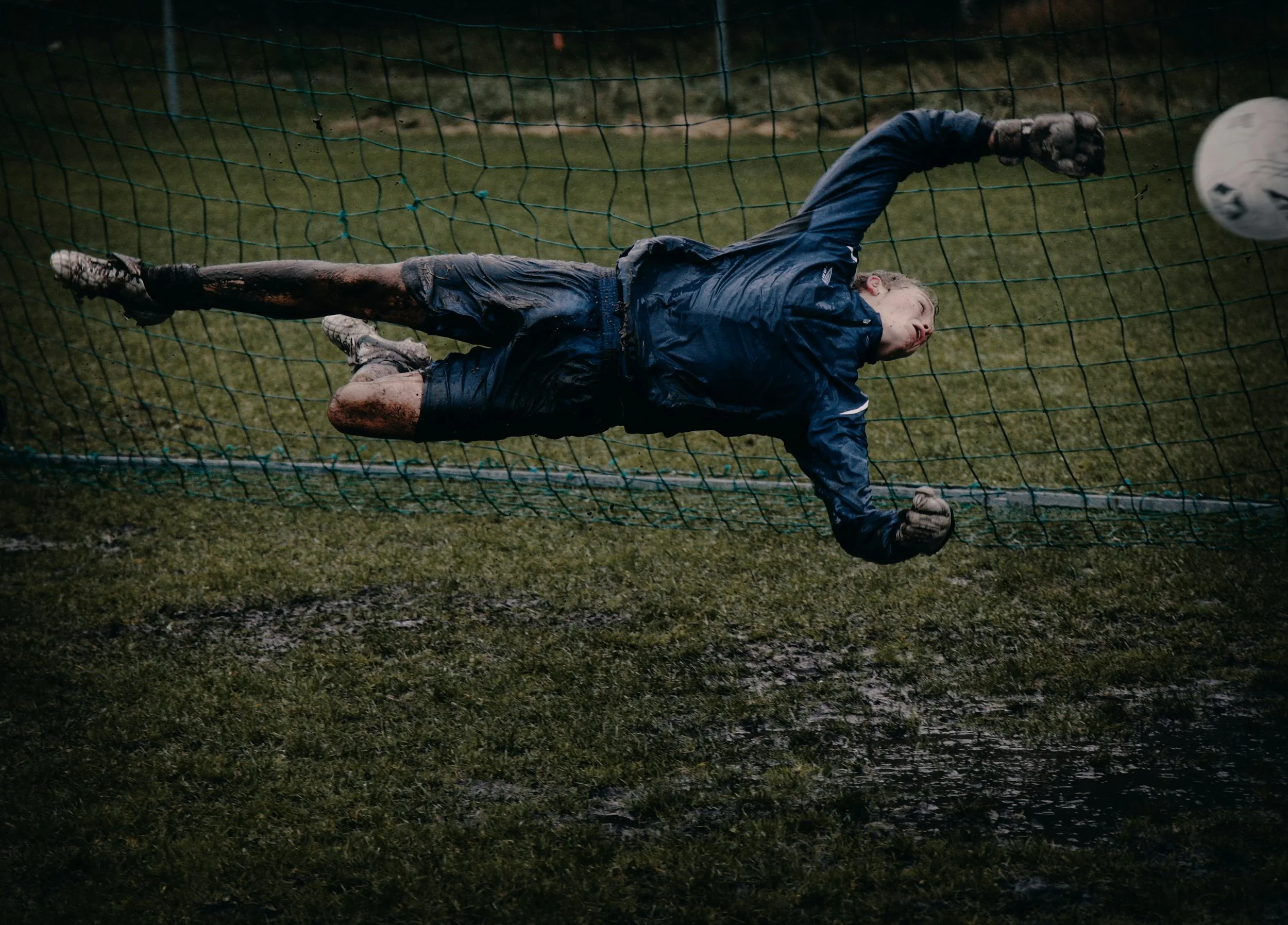
I am sitting on the red lips sofa in the café Ritz with Jock and Stephen, each of us in our favourite football shirt. We discuss the latest football gossip while waiting for the bible study group to begin. Then Alice, a red-hot firecracker of a ten year old, comes downstairs and proceeds to tell us a most remarkable story.
Even before the story is told, the air freezes. Bradley, our leader, and Elise, Alice's young mother, look at one another.
What's this, I think; didn't they know that Alice was upstairs?
Alice tells the story as an innocent. Out of the mouths of babes, I sigh, when she has finished. Then I linger on the images of Elise and Bradley in the bedroom above us: hands on chests, trousers around ankles.
I can just imagine retelling the story, with appropriate embellishment, to the lads in the dressing room. Even Mick, our captain, would look up from trying to flog his dodgy mobile phones, and listen.
'Good on 'im,' Mick will conclude: 'fair play to the fella; she a nice looking bird?'
'Yeah, very fit,' I'd say.
I look over to where Elise has retreated, watching and listening, in the back room of the café. Her milky white throat and face is English, but her beach-blonde hair could be from Bradley's native California. Nestled in her cleavage is a large wooden crucifix. Bradley met, saved and converted her at an alpha course in Southwark cathedral.
'And now he's reaping the rewards,' Mick will note: 'nice one.'
Mick will then turn to Jock, the big, quiet Scot who plays in front of me at centre back, and say, 'I didn't think you Christian boys were allowed to go around shagging other people.'
Jock will squirm and wither under the interrogation, just as he squirms and withers under any serious pressure from an attacking forward. He will defend valiantly for a while, moving his big white body to block the in-routes to my goal, but then, usually halfway through the second half, his head will go down. He will get skinned in the next attack and left for dead by the opposing team's blitzkrieg. I will have to rush off my line and dive at the forward's feet, if I'm quick enough.
'Why Mummy?' bleats Alice. 'Daddy won't come back now.' Alice stands before Elise, little hands on little hips, pouting. 'Daddy won't like this,' she says. 'He said you weren't to do this.'
In a soft voice, Elise shushes her daughter. She tries to remove her from the limelight, pulling at the sleeve of her maroon velvet dress, but the little truth-teller is not going anywhere quietly. Alice is a guerrilla fighter, fighting for what is right. Out flashes a small yellow sandaled foot, and a blue, leather-bottomed pouf rolls over lazily and becomes a black eye.
I look at the toppled pouf and see it as a smirch on the hardwood floor, a stain on this place.
Alice struggles free from her mother, who gives up trying to quell the source of her embarrassment and moves away to the furthest corner of the shop, near the front door.
Then another ten year old girl comes downstairs. This is Jane, Bradley's daughter, who shrinks into the protection of her father's embrace and glowers at Alice.
Alice scrapes the sun-bleached hair from her wet cheeks and glowers back. She's a handful now; imagine her in a few years time. She turns to us on the sofa and looks each one of us in the eye. We all inspect the hardwood floor.
'Come and sit down,' says Stephen. He reaches forward, rights the abused pouf and brushes the top clean. To my surprise, Alice sits on the pouf and treats us all to a winning smile: a bright banana smile that splits across her face. She's the coca-cola girl, but tonight she has had to grow up fast. How on earth is Bradley going to wriggle out of this one?
I watch Bradley chew his bottom lip as he holds onto Jane. He is fifty years old, a charismatic man of the world, yet he is frightened by Alice's allegation. Any one of us could mention this fact to his church superiors and he would be out on his ear.
'Should own up to it,' Mick would advise. 'Dip your wick, you pay the price.' Mick's been in and out of prison twice; he's another man of the world who knows the cost of things.
A mournful silence grips the café Ritz. Bradley Ritz, the proprietor, strokes his daughter's hair with one hand, and strokes his beard with another. I can see him thinking: there must be another interpretation I can spin on this; if Clinton can do it, so can I.
The funny thing is, now that the air in the café has warmed up again, we have all concluded that Alice's story is true.
I settle back on the sofa, and realise that I'm rather enjoying Bradley's predicament. I'm only here because of recent events, and because it was the only way I could get Stephen and Jock to shut up about their faith.
Stephen who wears a Leeds shirt, the brand new yellow one, not that he's ever been north of the Watford gap. Jock and I let it go because Stephen's a bit fragile and he's a mate.
Jock wears an old Arsenal shirt. He's a true Gunners man, from way before the Premiership and all the Henry adverts. Now Jock does his best to be a rock, both on the football field and off, and I can see what he's thinking too, because we've had this discussion before. Jock will be thinking that there is only one punishment fit for Bradley. He will be thinking that our once esteemed leader, a man previously known to be a good Christian, and a guide into the mysteries of the bible, will in fact be on the next express service to hell.
I know this because, you see, until recently, I was going to hell too.
'That's a bit harsh, isn't it,' I protested when Jock had announced the sorry news. 'I mean, we might get relegated, but going to hell is a bit strong.'
'You're not saved, Peter,' Jock explained, 'you are in limbo; you are not in a state of grace. None of us are until we open ourselves up to the Lord.'
I didn't want to be rude to Jock, because I've found it always pays to keep an open mind, but I kept him at arms length for a bit, and continued to curse his lack of legs and commitment in the second half. Picking the ball out of the back of the net, I would turn and invariably see him standing on the penalty spot looking exhausted. He would come over, slap me on the back, and say that was all he had, that the other team was fitter and stronger.
'Fight, man,' I told him, when I could not stand it any longer. We were in the dressing room, the banter of another defeat over, and the team had moved on to the pub. The air was warm and moist, the mist slowly clearing from the showers dripping in the background. I suggested to him that he should fight harder, try and get back and win the ball, never give up.
'Don't you ever get tired of struggling?' Jock said. 'Each of us here can only do our best.'
I'm wearing a green goalkeeper's shirt with 'Camus' and '1' on the back. The missus got me it the other day. It combines my love of football and philosophy. Albert Camus was a writer and a philosopher, a leading existentialist, and a leader in the French Resistance movement during the war. Better than all that, he played in goal for the Algiers Racing University Club. Apparently, he said that he learnt all about morality and obligations from football. I can see how that could happen. Even now I still feel obliged to save the day.
Red, yellow, green goes our football traffic light, but I'd never let Mick see me in this shirt. Only the blue stripes of the King's Head will do. Even though we're bouncing off the bottom of our division in the Harlesden and Willesden district Sunday league, we're still proud of the team and the club.
I like Jock so I would never tell him what I really thought, that he was defeatist, and too quick to say that it was all in the hands of the Lord, a mysterious centre-forward who I had heard plenty about, but had never actually seen play.
But that was before I was involved in a road accident, hit by a driver coming towards me on the wrong side of the road. I remember looking at the car and thinking: that can't be right, and then the car hit mine, and the windscreen crazed and there was a pain in my head and chest and knees and that was that for a while.
When I awoke, it was because the surgeons had saved my spinal cord from a wayward cervical vertebra. I can eat and drink today thanks to the ambulance men who took the time to pick my teeth off the dashboard. They even put most of them in the right way round, ramming the enamel back into my bloody gums while I was unconscious, before the nerves died.
I wanted to kill the other driver, who survived with a cut lip, that's all, when I was discharged from hospital and I was told that my playing days were over. But the impulse faded in the warmth of the bosom of my family and I was glad just to be alive.
'You were saved,' said Jock, inevitably.
'I was saved because several healthcare professionals did their jobs expertly,' I replied with difficulty, the effort of talking too much then as it is now. Bother words; action is what is needed.
'Yes, the Lord was acting through them; that's how he works.'
I didn't have the strength to argue; I saved it all for the physiotherapy, and learning to walk again.
But it did make me think. The consultant showed me the X-ray of my spine, and pointed out the number of millimetres separating me from this world and the next. He said I was lucky. Camus had not been so lucky. He was killed in a road accident in 1960. Jock kept telling me that I had been saved, and on one emotional day, with my six year old in my lap sobbing that she was glad Daddy was still here, I gave in.
'Okay, Jock,' I said, 'I'm an open-minded sort of guy. I'd like to find out more.'
Jock was overjoyed, and a little bit surprised, that he had convinced me. I had previously suspected that there was kudos to be won for such evangelical endeavours, and I was right. Stephen now regarded Jock with awe, as if the sun shone out of his arse, and he joined the bible study group when I did, the tart.
Bradley's mirror is forever cracked, however. His gorilla arms are now wrapped around Jane, who is struggling to escape. Every now and then he raises his eyes to the ceiling, to the site of his alleged misdemeanour.
I don't want to be here when Lydia walks in. Forget the fire and brimstone; hell hath no fury like Mrs Ritz scorned. We should all leave. My wife will be pleased to see me back so early.
Bradley bends down, turns Jane around to look at him, and begins to whisper in her ear. He will be speaking in paragraphs, and his defence will have a beginning, middle and end. Whatever he says, as he strokes Jane's shoulder-length brown hair, seems to appease her.
We have been distracted. How funny it is that when a kid is peaceful and quiet, she disappears.
Alice makes her move, dashing past Clara and thumping upstairs in her yellow sandals, a trail of dust rising up from the old brown carpet. Jane squeals and attempts to follow.
'No, stay here darling. Alice is confused.' Bradley pulls a blue lollipop from his shirt pocket and fairly stuffs it into Jane's mouth.
There is silence until we hear a bang and then movement above us in Jane's bedroom. Jane spits the lollipop on the floor. She screams and breaks free of her father, scrambling up the stairs after Alice.
Soon there are screams above us; first Jane, then Alice, mocking her. The bedroom door rattles with a series of loud thumps.
Jane's head appears midway down the stairs. Normally a demure girl, her hair is twisted into knots. 'Dad, Alice has locked herself in my room! Get her out, Dad! She'll break my toys.'
Bradley trudges upstairs, a beaten man.
A chair is being dragged across the bedroom floor. What is Alice up to? Then there is the unmistakable sound of a small hand hitting a window frame. Alice is standing on a chair, trying to open Jane's bedroom window.
The doctors said I should take it easy, but somehow I know what is coming. I do believe that Alice is now attempting to dispose of Jane's pet mouse out of the window.
It is a huge effort to get off the sofa. Stephen helps me with a hand underneath my elbow. Jock passes me my crutch.
The banging increases upstairs. Bradley is thumping the bedroom door, and demanding that Alice open it.
I'm summoning the energy to tell Stephen and Jock what I think Alice is up to, when Lydia walks in. The first person she meets in the café is Elise, who had been looking at her ghostly reflection in the front door. She moves away but she will haunt this place for a while yet.
'Hello, Elise!' says Lydia. 'How are you? How are your discussions going?'
The shit will surely hit the fan now. It's a similar feeling to when the final whistle draws near. As usual our defence is strung out like the Maginot line, and half the team has ceased to care. The midfield is pretending to be supporting the attack, and no one can be arsed to run back to defend.
Jock moves past me into the back room. Oh, if only I had a pair of working legs! He lights up a cigarette and takes a long drag. The smoke wafts over, a little bit of hashish to steady the nerves. Then he sits on the floor in a heap and starts to thumb through a pile of second-hand detective novels.
Stephen is in the kitchen, with a coffee mug frozen to his mouth. He says its only lemonade, but we found an empty bottle of ready mixed gin and tonic in the bin last week, so his secret is out too.
It is very quiet. The banging upstairs has stopped. Bradley and Jane must be hiding up there, Bradley possibly with his hand clamped over Jane's mouth.
Then I hear the sound of a window coming unstuck from its frame, and the rattle of the window-stay across the sill as it opens into the cold evening.
Keeper's ball! Keeper's ball! I'm rushing off my line as fast as I can go. I open the back door, put my right foot forward, and try to anticipate the distance down the step to the ground, how much to bend my knee, and finally how much it will hurt.
I barely land upright on the grass. I howl as the pain shoots up my leg into my head and rattles around my teeth. House lights and the penumbra of a street lamp light the garden. Hobbling around the corner of the house on my crutch, I see Jane's bedroom window open above me.
Alice's hand appears out of the window. She holds a silver cage. Inside the cage, a small white mouse clings to the bars.
Alice shakes the cage vigorously. She is trying to free her fingers, which are stuck between the bars. Then she will be able to drop the cage and rid herself of her friend's pet, an animal that provides Jane, and therefore Bradley, with far too much happiness.
The logic is all there: the logic of retribution. In a way, I admire Alice's spirit, but my heart hardens to her methods. I am dismayed; truly, man is alone. What resource of the supernatural world could help us now?
Don't drop it! Wait a minute, I'm not ready!
When I was a young boy, I would roll up a pair of socks into a ball, throw it against my bedroom wall and dive onto the bed to catch the rebound. I would do this again and again, varying the angle and power of the throw until my mother arrived and scolded me about breaking the bedsprings.
In school, I played goalkeeper for the football team, and also at college, and then for the King's Head. I am very defensive towards my family, over and above my friends who are also fathers.
When in church for the Christmas communion, I daydream about terrorists who abseil though the stained glass window and take the congregation hostage. Only I escape and raise the alarm. I still daydream like this.
Thus, if this were the last shot of the game, and it was just me standing between a well struck penalty and the undefended English goal, millions around the world would see my fit and supple body arc into flight and my fingernails telescope into eagle's talons.
I would pluck the cage from the frigid night air and hug it to my chest, before it could bounce and break on the ground. It would be an ejaculatory ending.
Truth is, I stumbled and lost my crutch. The cage fell quickly and hit the ground and the mouse died inside.
I did have the impulse to dive and save it, to keep fighting, but Jock held me tight and stopped me from breaking my neck.
© Mark Carew 2005
Photo by Vidar Nordli-Mathisen on Unsplash
Cricket in the Rain
First published in Buzzwords magazine, UK, issue 23
2003
The cricket called all this night and the last. As tourists we can not shut him out, or pull up his stumps. In the garden of our country cabin, a cricket rubs a stick up and down its serrated wings, and steals our sleep.'Cricket, cricket,' it chirps, right outside the window, oblivious to the rain. My wife's newly cropped bob turns in frustration on the pillow. In the dark, her disembodied hand motions weakly at the window.' Virginia is for lovers,' she croaks.
We are 25 years down the married line, first-time visitors to the US, far from our home in London. This is our second honeymoon. Nothing is to spoil it.
I sigh and pick up my wife's polka-dotted parasol. The cricket will have to go.
'You're de mon,' mumbles the pillow.
An electric torch lights my way out onto a deck that pulses with the memory of the summer sun. The cricket continues to call, disguising its position against the backdrop of night-time chatter. Nature's sauna is steamy and busy with the beat of tiny wings.
Bending back the heart-shaped leaves of the rosebud tree does not reveal the cricket's hiding place, nor does tapping the waterwheel at the end of the garden. Not that I dally there; America has spiders that jump.
There is a gate in the wall behind the waterwheel. This is interesting. Americans aren't big on private gardens, at least in the South; it suggests a lack of community spirit. So far we've only seen flat bungaloid buildings and huge back yards with absolutely no privacy. A walled garden must mean something. The cricket must be hiding in there. My hand is on the gate when a voice deep from within the cabin asks whether I have found it yet.
Oh, sure, an inch-long insect in a haystack, no problem.
'Nearly, honey,' I say, feeling the wet wooden gate slippery under my hand, feeling something irrevocable starting.
The gate opens and I enter the garden. Baby dragons awake in the rhododendrons. They poke out tongues of cheeky mange tout, as my torch sweeps by. My flat boat shoes burrow into freshly turned soil. I kick them off and rub the warm earth between my toes. My dressing gown slips open. The sap is rising, as they say. I hang the parasol in a tree and rearrange my modesty. I am fifty-three, married with children, shy.
Reaching back up, I catch my finger on a thorn. Shout and swear, the silence falls apart as the torch rolls and rattles on the ground.
But doesn't the rain taste good on my stuck finger! I suck in the taste of iron. My mouth opens a little wider and speaks to the night sky; a timid cup blocked by an anxious tongue, anxious to avoid spiders hanging from trees. Laughter spills over my chin and down my hairless white chest.
An indigo bunting lifts off into the lilac sky and lands in the middle distance amongst new saplings. I can imagine the bird, flying over the Blue Ridge Mountains, looking down on Rocky Knob and Rock Castle Gorge, watching the deer running through the flame azaleas.
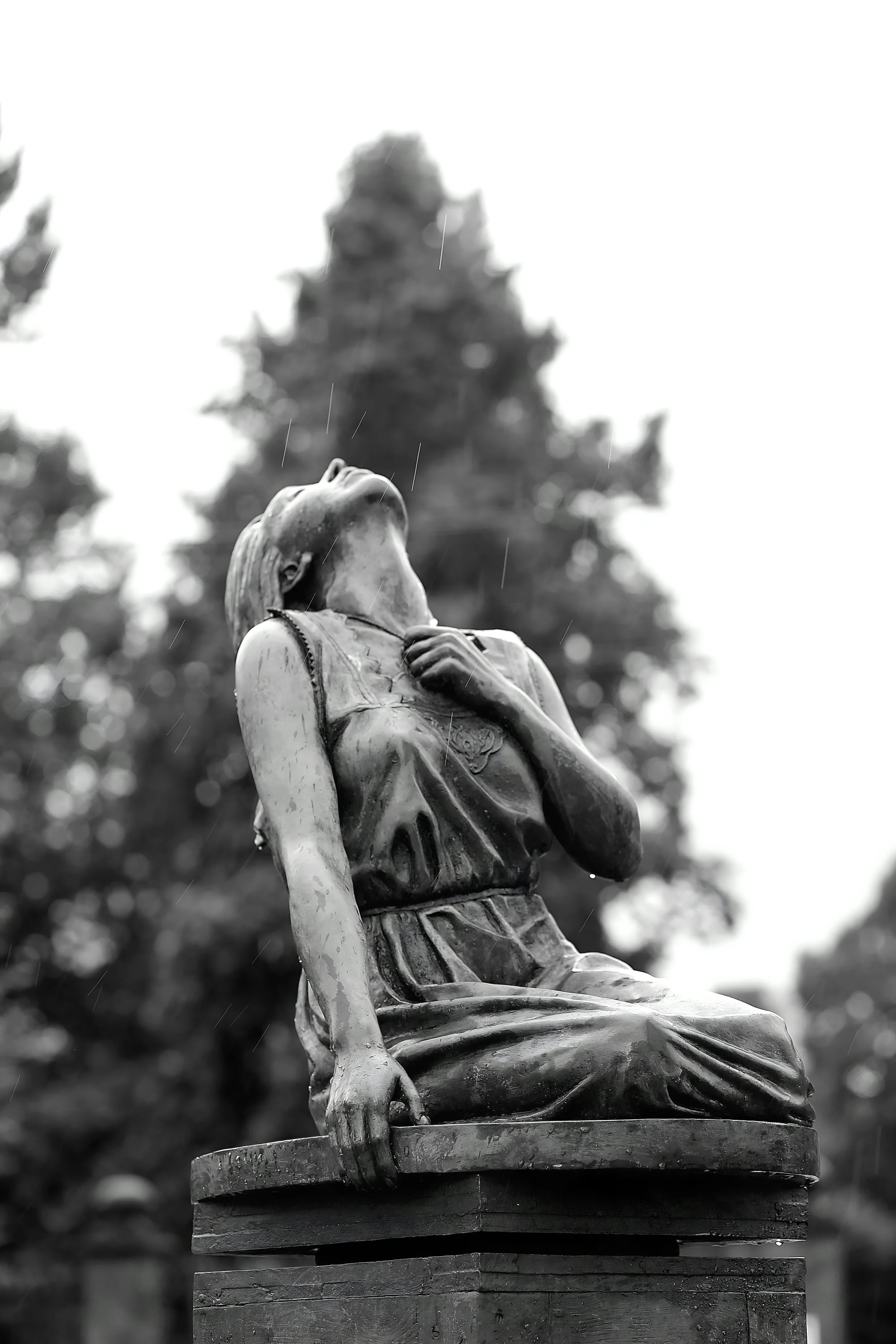
It is suddenly very quiet; the rain has eased off. My eyes have adjusted to the dark. I am not alone. A young woman stands in the middle of the garden. Her back is to me and her head is cocked to one side. She carries a bowl in each hand at shoulder-height. The torch ended up behind her, bathing her dress in a secret, eerie glow.
I greet her softly, tensed for her reaction.
She does not respond. I walk around her and see that she is a statue. It is midnight in the Garden of the Seen and Unseen, and a revelation awaits me.
The cricket is frozen in the middle of one of the proffered bowls. It is huge and prismatic. It is ten times the size of English grasshoppers. The torchlight splits into a rainbow across its iridescent green body.
'Cricket, cricket,' it calls, and then is gone.
Oh, you clever little insect! That you called me here!
The rain pours down and drags the hot gown off my shoulders.
Greetings and worshipful splendors to your goddess!
She caresses me; opens me up like a flower, and drips hot oils onto my chest. Where it pools at the sternum, I rub it in. She breathes on me the perfume of pine and dogwood. I cavort naked. I am a child in paradise.
My soul soars with the birds above the imperturbable mountains. There are no clouds in the sky. My quest is over. I am a man, a wolf, a stag, roving in the forests of the world. Stoic trees envy me. Flowers and butterflies evanesce. I am in the autumn of my life, but it feels like summer.
At the peak of my epiphany, I hear a voice.
'Laugh with me,' the young girl says, 'laugh at your expedition and your lost trappings. Do not sleep. Leave her. Be with me.' And her hands run like rain over my head.
© Mark Carew 2003
Photo by Nithin Nandakumar on Unsplash
Good for Nothing
The Richmond Review, UK
2002

She set herself out in a little boat, she sent herself out to the sea. And when she got back in her little boat, this is what she said to me.
This is what she said to me, in the gallery in front of the painting where it had all begun.
She said she was free, free of her duty to her family, free of trying so hard to be superhuman. She said she would try and love them with all the strength in her body. It was just that her strength ebbed and flowed.
She told me about her metaphysical journey while looking at the painting, munching a packet of crisps.
The unattainable goal of right living is to be good for nothing, no reward, no reason, no supernatural Brownie points to set you up in a nice sunny spot in heaven. Just be good for its own sake.
She said it was impossible, but you had to try. She said reading Iris Murdoch helped her to realise that she was a moral hero. She had always thought of herself as a moral saint. But doing good was never easy for her; she was always struggling with it, while others found it natural, easy, like water off a duck's back. She was torn between doing good, aware of its utility, mindful of her duty, or judging those she was kind towards, did great works for.
I said that I thought people always needed a reward, some feedback to know that they had done the right thing, however altruistic they might feel.
She said I was a moral hero too.
She had three stories for me that culminated, in her mind, in the picture ahead of us, which in turn had stimulated and inspired her to address why she always had to be in control. She had come to hate her huge ego, in a place unspotted by science, trying to force everything in the world to go her way. Always worrying, always wanting to change things, never accepting the negatives in her life, always struggling with her duty to her family.
In the first tale, she had rung her father on his birthday. They had never been close, but she hoped that they were getting closer. Some families are like that, four people without a shared gene between them, who after an hour in the same room are itching to escape and watch their separate televisions. Her father was out, so she left a message. She spent the rest of the evening and the next day waiting for his call. Two days later she sent a text message to her brother on his new mobile phone to ask if all was OK. A recurring dream of hers is of visiting home to find the house decked out in white lilies and the living room full of strangers drinking asti spumante. On this occasion, apparently all was well; her brother had asked their father to ring her. On the third day, she called her brother again. He was irritated. He had passed the message on; their father had received her birthday wishes, what more could he do?
She had done the right thing; she had maintained contact on a birthday. She had done it because she loved her father and because it was obviously the right thing to do. So why, four days after the event, sulking in her shared house, while her girlfriends told her to chill and watch the video, why had she felt so bad, so alone, not particularly worried, but just alone, as if she had been born into a vacuum. Because, she said, holding up a golden crisp to the white gallery walls, she had wanted her reward.
On the fifth evening after his birthday, her father phoned her and they had a good chat. There had been no particular apology for the delay, and when she asked him if he had had a good birthday, her father said mixed, what with all the stress here. The situation is known to both of them; how he copes she never knows.
She said she had been selfish; she had not been good for nothing.
I sat quietly and thought about her struggle. Her family did not care for her, and possibly did not care for each other. She was castigating herself for failing to live up to a debatable philosophical rule about goodness, a rule that she had set in stone, a rule that had the saint with her foot on the hero's breastplate.
Earlier in our sessions, it became clear that she gained pleasure, or reward, from very few sources. So to know that she had done the right thing by addressing the complex question of her family with no explicit regard for her feelings, just wanting to be in orbit around them, was to her very important. Because even if you know that you are good (and clever, with psychological insight and philosophical resignation) you still want to hear it, hear that you are good.
I suggested, as she crumpled the crisp packet into a ball and placed it in her coat pocket, that she did not like anyone to be negligent of her concern. She wanted them to know that she cared about them, and critically she needed to know that they appreciated her concern, otherwise she might question the whole point of her bothering.
She nodded and said that this was clear to her now.
I looked at her closely. Indeed, she knew this was true.
Then she told me her second tale, about her brother.
Her brother had been an artist on the brink of success until his girlfriend and financial support walked out the door. Determined to create a phoenix out of the ashes, he was using the experience to generate a series of art objects on the theme of hope out of disaster. He had painted the picture in front of us. It was a powerful image to some audiences, but mawkish or plain naïf to others, like that picture popular in poster shops of a whale's tail breaking above the ocean. Her brother's painting was nautical too, but in the style of Friedrich's lonely landscapes. The small white card to the side of it said that it was Romantic irony on a grand scale. Some of the people treading softly past us on the wine red carpet may have sniggered as they approached our bench. They may have sniggered too at the tall man with the twitchy arm and the young woman in the duffel coat, possible his daughter, seemingly entranced by the vision ahead of them. On the other hand, other visitors to the gallery, like my analysand, may have said that they really liked it.
I asked whether this was because of the family connection. Yes, she said, maybe that is something we share: hope.
Despite this one picture exhibited in a Hampstead gallery, her brother said that he required funds for materials so he could paint other pictures as they came to him, and money so that he could eat and keep warm. He had accepted a set of ten canvases from his father as a present (she had been at school the last time she had received a thoughtful gift) but had refused his money. She visited him in his so-called flat. Whose patronage he lived under was unclear to her. The new canvases were untouched. He had the flu; she bought him Beechams, and offered to cook dinner. He was manful and said he was eating fine and saving for some new shoes. He was pale and sweaty. She felt sorry for him and handed him fifty pounds, a bright flat note you could cut your finger on. When the bank teller had issued it to her, she took it as a sign that her actions were correct.
I asked her to explain what she meant by a sign.
She said it was just that, a simple sign, without origin or intent, a coincidence that only she could, or would, recognise.
I asked her if there was a reward connected to the sign.
She said none. All the sign had done was to encourage her to think that she had done the right thing.
I asked her what, or who, it was that had really given her the encouragement.
She said that she had.
The day after visiting her brother, she phoned him to say how much she had enjoyed seeing him again, and that they must stay in touch more often, and he could visit her in Camden any time. Her brother made an effort to quiet his friends in the noisy bar and step into an alcove that might resemble acoustically the walls of his sorry squat. She said she was glad to hear he was having a good time and that everyone needs a good blow-out once in a while. She kept the lightness in her voice until they finished their call.
Always in control, father must do this, brother must do that. Only then, when their actions are commensurate with my theory of how life shall proceed will I be happy. She said this standing up, standing to attention, buttoning up her coat so that her head disappeared into its collars. She saluted me and marched like a clockwork rule-led toy across the gallery floor. Then she stopped, relaxed, unbuttoned her brown duffel coat and said that she was a person not a textbook.
She has made terrific progress. My Tuesday afternoons will be much less therapeutic.
I asked her to tell me her third and final story.
She dropped her coat on the floor and sat down next to me. She wore a yellow summer dress with red poppies around the hem. Vitalised by the light of the picture, the warmth from the white candle with the yellow flame in the silver night stand in the brown rowing boat without oars on a green, tempestuous sea, she told me about the last time she had seen her mother.
It had been a week ago, three days before this meeting, our last.
She was clearing up in her parents' kitchen. She had gone back home, as she did once or twice a year, to check that she had not missed their funerals.
She had washed up, soaked under the draining board, stacked the dishwasher, put the empty baked beans cans stuffed with wrappers and the empty milk and orange juice containers in the white plastic pedal-bin bag. She cleaned the cat's food and water bowls and the litter tray: they were all clean enough anyway; they looked after the moggy better than each other. She reorganised the larder, dusted the shelves with her hand, and threw out six different breakfast cereals past their sell-by date. She wiped the jam off the lid of the strawberry jam jar with a damp paper towel, because sticky fingers always irritated her mother at breakfast. She wiped the crumbs off the work surfaces and scrubbed the butcher's block hard with detergent and wire wool until the flecks of dried meat dissolved. She swept the floor and repositioned the chairs and kitchen table, the ridiculously small table that got smaller every time she went home - now it was the size of a dinner plate ' where they had learnt to despise every slipped, dribbling spoonful and each open, compacting mouth. She cleaned the top of the white plastic pedal swing-bin, and took the bulging bag outside to the kerb for collection the next morning.
Finished with her great labour, she made herself a cup of tea, took a biscuit from the Quality Street tin, and sat down at the table. She listened to the competing yak-yak of the two distant televisions, and wondered why she bothered.
When her depressing soap was over, her mother had entered the kitchen. She looked at her daughter with disgust, and asked why she had not been offered a cup of tea or a biscuit.
We laughed when her mother called her good for nothing. We laughed again when her daughter said no, in fact, she was not good for nothing: she was a moral hero who strove to be a moral saint, but that she would fail often in the fight because this battle was too big for her. She left the house with her tea slopping onto the clean and minuscule table.
When we had sat quietly for a few minutes, she said that she intended to orbit the familial home as the moon orbits the earth. She knew she would wax and wane in the strength of her love and light, but she would be present nonetheless. It was all anyone could do.
In the silence of the gallery, in front of her favourite picture, I confirmed she was free.
She leant over to me, kissed my cheek and said thank you. How she glowed.
© Mark Carew 2002
Mouthpiece
Winner, Second Prize, Fiction Writing Contest (2000), Smallmouth Press, New York, NY.
The suspect sweated under the lights in the interview room like a cheap sandwich in plastic wrap.
'So, you think you're a big character,' said Detective McBrade. 'You want respect. You want all the fine folks who read the New York Times and Washington Post to know what a criminal mastermind you are. Well I don't buy it. You say you're bad. Show me how bad you are.'
The suspect ran through the events of the bank job. Detective McBrade listened to his monotone without interest.
When the suspect finished speaking, McBrade got up from his chair and checked his appearance in a long mirror on the wall. His ebony skin shone in the tinted glass. He winked at the mirror.
Suddenly, he was in the suspect's face.
'You know your problem?' he said. 'You're a mouthpiece. You just describe what you see. You're a fly on the wall, a bird's eye view. You never get involved. How am I going to bust you for that?'
Sweat sprang from the suspect like exclamation marks.
'Look man,' he whined. 'I told you everything about that last caper, I told you how it went down. I'm a bad mother, you gotta understand that.'
McBrade took a fresh soda can from a vending machine and banged it hard on the table.
'Oh, sure, Mouthpiece. You're on the corner at ten o'clock, when the job goes down. You see the Big Man's guys go in the bank. You see the customers get on the floor. You see the clerks empty the registers. Then you see the getaway car drive off, and get caught by the cops.'
'Do you see what the problem is Mouthpiece? You're a fake. You're a storyteller, you ain't no big fella. You wander around near the action, but you never get in it. You don't do nothing bro'.'
McBrade moved to the door.
'What you doing?' whined Mouthpiece.
'I'm letting you go,' said McBrade, holding the door open, 'I don't need another eye witness.'
Mouthpiece stood up shaking. 'But you gotta charge me! I was there. I'm one of the Big Man's guys. If I don't get busted with them, they're gonna think I sold them out.'
'I don't do favors. You're free to go.'
'Please, man,' squealed Mouthpiece. 'I'm a major character in this.'
'Look, you freak. What you've told me, you could have read in any newspaper, or heard on the TV. The bank was full; the street was crowded. I've a got a book of people who tell me exactly what you did.'
McBrade shook his head. Not in thirty years of police work had he had a suspect so desperate to throw himself in jail. But a collar was a collar. It was what mattered in his line of work.
'Mouthpiece, you're one crazy cat, but I'm going to give you a break. If you can tell me something juicy about the Big Man, something I can't get from anyone else, then I'll see if the DA can't put you away.'
Mouthpiece swallowed. This was his big chance. This was his opportunity to be central to a really great story.
'There's a card game every Friday. The Big Man likes me to be there.'
'Why? What do you do?' asked McBrade.
'There's no one listening?' Mouthpiece pointed at the dark mirror.
'Nah, don't worry about it,' replied McBrade. He smiled at the invisible audience waiting for Mouthpiece to spill the beans.
'OK, well, the Big Man, like he's a really big man, and he has to sit in this really big chair, and because of that he can't reach the table. So he lets me hold his hand, and he tells me the cards he wants to play. I go over and put them on the table where all the other big guys are playing poker.'
'That's it?' asked McBrade. 'You're the Big Man's butler?'
'No wait, there's more,' said Mouthpiece, thinking quickly. He lowered his voice so McBrade had to bend over and get close to hear.
'The Big Man's a really bad poker player,' whispered Mouthpiece. 'I mean he's really rotten. He stinks. But he thinks he's great, and he's gotta win. If he doesn't win, I take the beating. So, I do the dealing, to the Big Man's advantage. But what he doesn't know is, I play the cards for him. And I'm good. I win. The other guys thank me for it. I keep the Big Man happy.'
McBrade stood up and loosened his tie. This guy was certifiable.
'Do I look like a charity to you, Mouthpiece. What should I arrest you for? Being a soft touch?'
'Yeah, well it's not only cards I deal out. There's manilla envelopes as well. I don't look inside, but you can guess.'
McBrade rubbed the stubble on his chin. The police occasionally turned up such envelopes, stuffed with hundred dollar bills, or coke, or photographs of politicians in bordellos. If what Mouthpiece said was true, then he was an accessory to a lot of heavy-duty crime. The City of New York could easily put him away for two to five.
But rather than dump him in the trash with all the other cardboard cutouts, what if McBrade worked on Mouthpiece as a snitch? At the moment, Mouthpiece was just a voice-over in the dark, a mere narrator who passed along from one scene to the next. But if Mouthpiece was built up, and made integral to the plot of the Big Man's operations, then who knows what story would emerge: with Detective McBrade as its hero, of course.
McBrade turned off the lights and drained his soda. Mouthpiece faded into the shadows. The guy sure needed developing.
© Mark Carew 2000
Image: unsplash-image-O9RZMEUUSpo.jpg