
What The Pharma? card game
Learn clinical pharmacology the fun way!
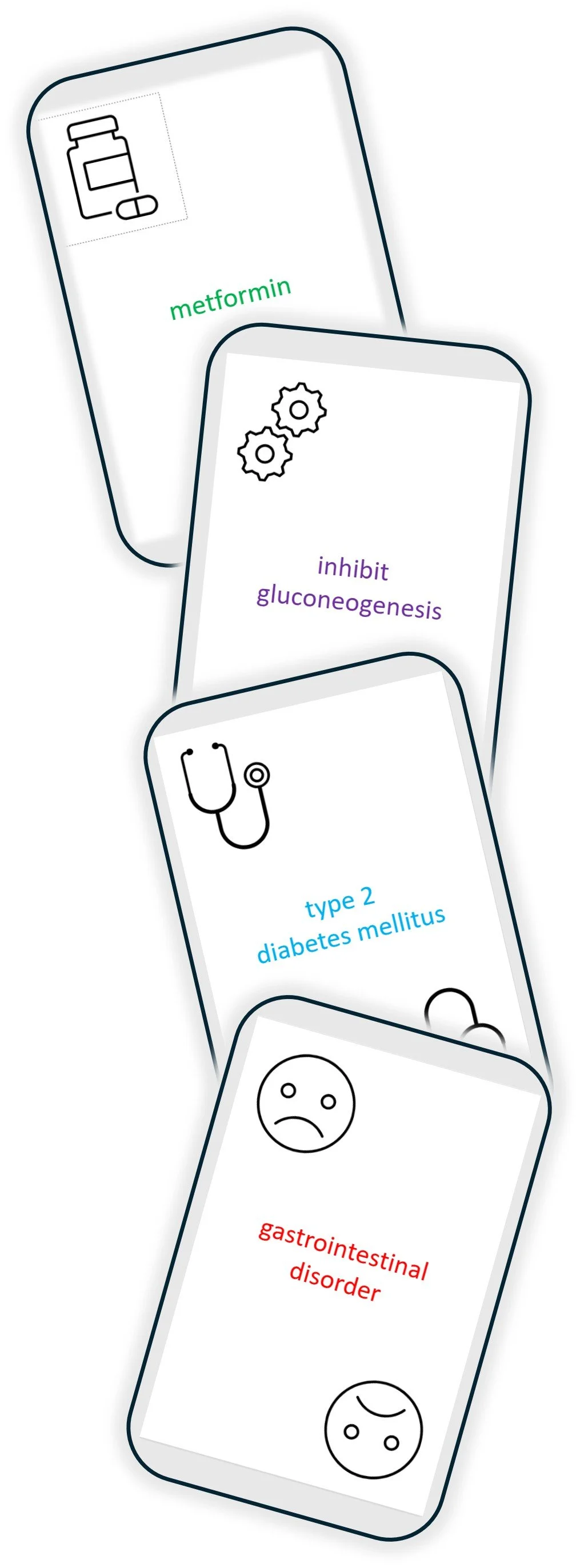
What The Pharma? is a card game invented by Dr Mark Carew (Senior Lecturer in Biomedical Sciences, University of Exeter) and Dr Robert Arbuthnott (FY2 Doctor) in 2024.
The game is ideal for students of medicine, pharmacy, nursing, independent prescribing, who need to revise the basics of clinical pharmacology.
Each deck of What The Pharma? has 52 cards with the traditional suits (spades, hearts, diamonds, clubs) replaced by the new suits of drugs, mechanisms of actions, indications, and side effects/prescribing note.
The cards are used in three ways to teach and help students revise the basic facts about commonly prescribed drugs.
Describe the word(s) on a card to your team. Without saying any of the words on the card (much like in the game Articulate). See how many cards you can describe in a short period of time. Excellent for verbal comprehension of the words used in clinical pharmacology.
Match the cards into sets. Each set is made of four cards (drug, mechanisms of action, indication, and side effect/prescribing note). Put all the cards face up on a table and make sets of four cards. See how drugs and mechanisms are constant, but there is often more than one indication or side effect of a drug.
Play Rummy (ye olde card game). Deal 7 cards to each of up to 6 players. The object of the game is to play sets of cards and explain the clinical logic of the set, thereby demonstrating understanding of the topic. Be the first to play all your cards from your hand to win the game.
Seven decks of cards covering 84 commonly prescribed drugs are available:
Deck 1: adenosine, amiodarone, digoxin, atropine, rivaroxaban, warfarin, enoxaparin, aspirin, clopidogrel, bisoprolol, ipratroprium, salbutamol
Deck 2: amlodipine, spironolactone, furosemide, indapamide, simvastatin, glyceryl trinitrate, ramipril, losartan, adrenaline, alteplase, fluticasone, montelukast
Deck 3: metformin, alendronic acid, sitagliptin, ethinylestradiol/desogestrel, formoterol/budesonide, insulin, gliclazide, prednisolone, levothryoxine, canagliflozin, semaglutide, hydrocortisone
Deck 4: vanlafaxine, citalopram, amitriptyline, haloperidol, ondansetron, olanazapine, donepezil, metoclopramide, benzylpenicillin, flucoloxacillin, setraline, doxycycline
Deck 5: risperidone, diazepam, zopiclone, Oramorph, carbamazepine, cyclizine, sumatriptan, co-careldopa, vancomycin, clotrimazole, aciclovir, ciprofloxacin
Deck 6: tamoxifen, allupurinol, naproxen, activated charcoal, codeine, ibuprofen, naloxone, gentamicin, cefalexin, trimethoprim, solifenacin, sildenafil
Deck 7: sodium valproate, methotrexate, calcium gluconate, paracetamol, morphine, tramadol, acetylcystein, clarithromycin, metronidazole, amoxicillin, finasteride, tamsulosin
Please contact Dr Mark Carew (m.a.carew@exeter.ac.uk) to order copies of a deck with estimated postage/packaging depending on country.
As an example, the cost of 12 copies of a deck with UK delivery is xxx.
In addition to the decks, you get discussion of the drugs etc. on the cards, and advice on how best to use the cards in teaching sessions.